
AI SECURITY REVIEW
PRODUCTIV | 2025
Senior product designer leading UX/UI design, user research, usability testing, and interactive prototyping while collaborating closely with Product Management and Engineering.
MY ROLE
The project spanned 2 months, moving from initial problem identification through discovery and testing to engineering-ready handoff.
TIMELINE
AN OVERWHELMING AND INFLEXIBLE AI EVALUATION EXPERIENCE
Security teams did not know where to start or what specific criteria were critical when evaluating AI security. Because they lacked a standardized process, the sheer volume of data created heavy cognitive overhead, leaving them looking for direction or a guided process.
The legacy review flow only offered high-level statuses, notes, and tags. While Productiv’s AI pre-filled data to establish a baseline source of truth, the interface was completely static. If a customer remediated an issue or updated a setting/configuration in their app, they could not update the fields to reflect reality.
Because the product could not act as a dynamic source of truth, customers abandoned the portfolio entirely, exporting data to spreadsheets to track and manage their reviews externally.
THE PROBLEM


TRANSFORM COMPLEX WORKFLOWS INTO AN INTUITIVE AI REVIEW EXPERIENCE
To address the problem, we created an intuitive system that surfaces actionable insights and reduces cognitive load for customers. This streamlined experience allows organizations to confidently secure their application AI usage, which ultimately resulted in a 78% increase in ACV.
THE SOLUTION

UNSTRUCTURED PROCESSES & INFLEXIBLE FIELDS DROVE CUSTOMERS TO MANAGE REVIEWS EXTERNALLY, REDUCING PLATFORM ADOPTION
Designing an intuitive, structured framework required a highly iterative, 5-phase approach:
Conducted user interviews, analyzed platform usage data, and gathered insights from Customer Success and Sales to pinpoint the friction points driving low review adoption.
Initial exploration assumed users just needed an outlined list of tasks to complete. However, this approach proved far too simple for the reality of AI reviews, which required deeper contextual analysis. Shifting to an embedded step-by-step guidance model solved for context, but quickly became text-heavy and cluttered the UI. Leveraging insights from competitive research, the strategy pivoted entirely to a structured security review workflow modeled after trusted industry standards.
Partnered with PMs through multiple review cycles to refine user flows and prioritize features to minimize scope.
Validated the end-to-end solution by putting a high-fidelity interactive Figma Make prototype in front of real users to ensure the new workflow felt intuitive.
Collaborated closely with Engineering to ensure the proposed designs aligned well with underlying data structures and technical constraints. This feedback directly informed the final design iterations before handoff.
PROCESS
TRANSLATING COMPLEX WORKFLOWS INTO FEASIBLE DESIGN CONCEPTS
To start ideating, I created initial sketches and conceptual Figma wireframes to explore how to break down complex AI reviews. The goal of this phase was to pressure-test different UX frameworks, map out the information hierarchy, and collaborate with cross-functional partners to minimize scope for the initial launch.
IDEATION




A STRATEGIC, COMPREHENSIVE AI REVIEW SYSTEM
To resolve customer overwhelm and drive feature adoption, we transformed the workflow into an interactive evaluation system:
-
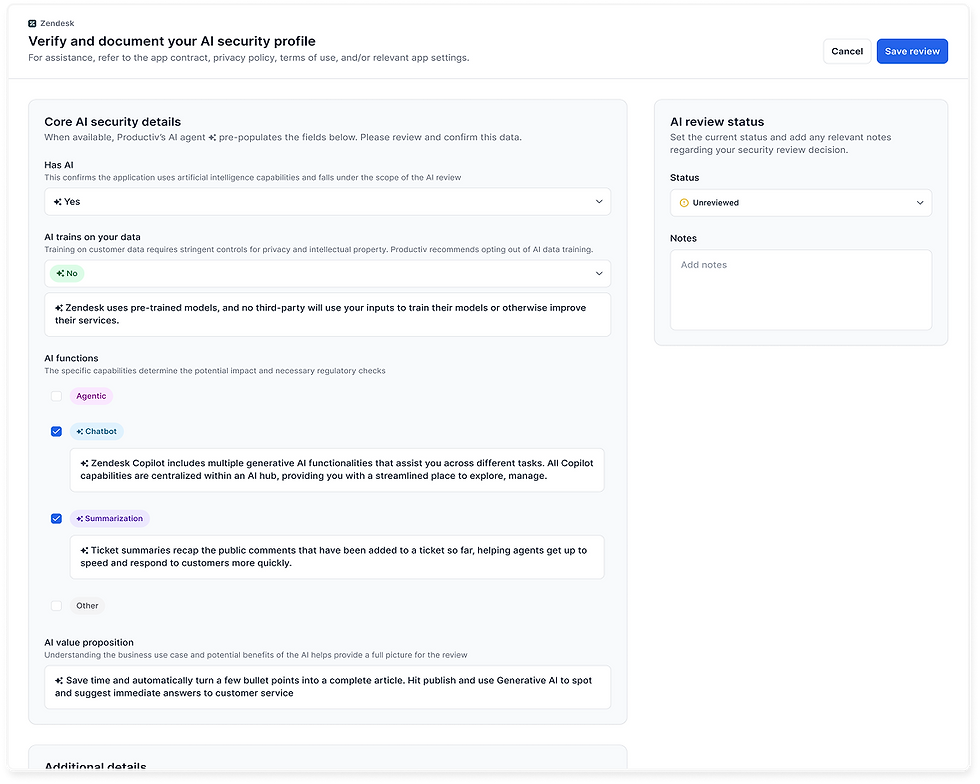
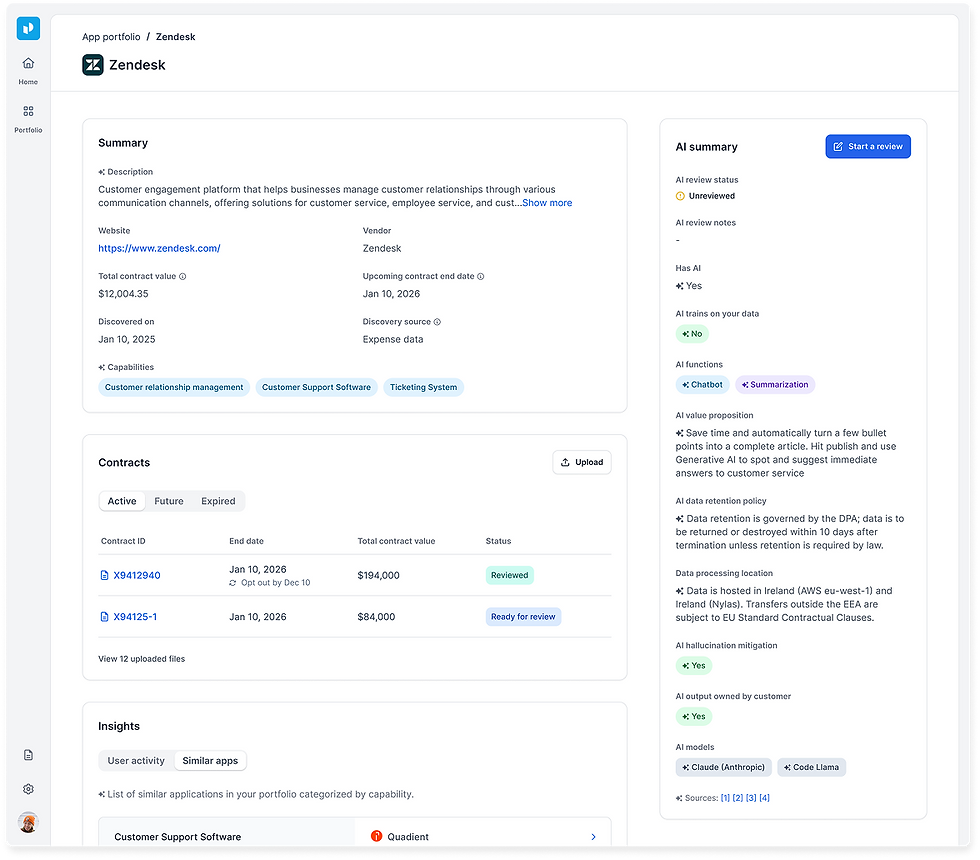
A Guided Starting Point: Defined a specific set of AI security fields pre-filled by Productiv’s AI, ensuring users know which data points are critical to evaluate right form the start.
-
Editable Source of Truth: Made all pre-filled fields fully interactive, allowing users to update data ans answers so the platform accurately reflects the current reality of their application configurations.
-
Unified Status & Context: Combined field updates with review statuses and notes, allowing users to seamlessly approve, reject, or mark as in review alongside their comments.
-
AI vs. Human Verification Indicators: Introduced a sparkle icon to visually distinguish AI data from user-reviewed data. The icon displays on pre-filled data and clears once a user saves changes or confirms the answer, making it easy to track what has been verified.
FINAL DESIGNS
THE NEW REVIEW EXPERIENCE DELIVERED IMMEDIATE IMPACT, DRIVING A 78% INCREASE IN ACV AND STRONG POSITIVE FEEDBACK
INCREASED PLATFORM ENGAGEMENT AND REVENUE ACCELERATION
Following the launch, qualitative and quantitative data confirmed the redesign was a success for both customers and the business:
-
Accelerated Business Growth: Directly contributed to a 78% increase in ACV in less than two months.
-
Elevated Customer Adoption: Active customer review usage increased, and Sales reported positive feedback, noting that the feature now serves as a strong selling point by providing clear direction on how to conduct an AI review.
The biggest takeaway from this project was that designing for an entirely new, unestablished company process requires eliminating anticipated effort at first glance. Because users had no existing mental model for AI reviews, simply putting critical data on the screen wasn’t enough. A novel workflow requires explicit guidance so users can understand exactly how to act on the information without feeling overwhelmed.
Moving forward, we will continue to monitor usage and iterate on the review process based on feedback.